It’s been some time since I have posted a thesis update- I’m not very good at keeping consistent with social media. But after having received my results on Friday, I decided it’s time to fill everyone in. Just an FYI- I got a High Distinction!!
SO, WHAT IS MY THESIS ACTUALLY ABOUT?
It feels nice to be able to finally have an answer to this question. My thesis, titled Wolf In Sheep’s Clothing: Reframing Girlhood and Sexuality within Feminist Revisions of “Little Red Riding Hood,” is a comparative close-textual analysis which examines Angela Carter’s short story “The Company of Wolves” (1979) and a selection of Nikita Gill’s poems, “The Woods Reincarnated” (2018), “Little Red Riding Hood” (2017) and “The Red Wolf” (2018). The aim of this was to demonstrate the significant shift in contemporary feminist values seen in revisions of Little Red Riding Hood.
While I don’t wish to divulge too many details (as I intend on further research and publication one day), I’d like to highlight that my thesis took a distinct approach to the conceptualisation of “innocence.” I believe I hinted to this a lot in my previous post “Woods of Wildness and Wonder,” (which is also a chapter sub-heading in my thesis), where I questioned why innocence cannot be celebrated and freed from its patriarchal connotations. This was a major concern for me when I started reading revisions of Little Red Riding Hood, especially considering Perrault and Grimm’s preoccupation with sexual innocence in the more “traditional,” “original” versions. Through my thesis I wished to examine how gender and sexuality have been framed, re-produced and challenged within discussions of girlhood. Why can’t Little Red Riding Hood simply be a story about a girl going on an adventure in the woods? Why can’t her “wildness” and curiosity be celebrated and explored, instead of ending with her own violation and a focus on her “naivety” to perpetuate a moral message? So I wanted to really highlight this and showcase how feminist texts have responded (and importantly if they responded) to this.
So in a nutshell, more needs to be done- though that is not to discredit the incredible work that has already been produced. I would argue that feminist fairy tale revisions are essential and must continue to be written, scrutinised and celebrated. While we will never reach a state of perfection that pleases everyone, is it not exciting to continue adapting the old and creating new things?
WHAT IS THE THESIS PROCESS, AND HOW DID I FEEL?
To do an Honour’s degree in Literary Studies at Deakin University full-time, I had to complete four coursework units across two Trimesters. While my course was online this year due to a smaller cohort, I couldn’t have been more fortunate to have such an amazing group of peers and such supportive tutors, lecturers and supervisors. I was honestly disappointed when I first found out the course would be online- and don’t get me wrong, some weeks were extremely difficult with motivation, but I never would have met the amazing people from Burwood otherwise, and I never would have been guided by my fabulous supervisor. But for anyone wondering, when did the actual thesis writing happen if I had coursework… In my personal experience, a lot of the serious writing didn’t happen until the beginning of the second Trimester in July. So essentially, I had three months from July to October where I absolutely busted my ass to produce some decent work. Though I think this is normal? You tend to spend a lot of time reading, and then re-reading and taking notes and changing ideas in the first half of the year so by the time you do get to writing full sentences, a lot of the work is just slapping it all together in some kind of coherent mess. But boy did I feel it when crunch time came around.
Some days were hard. Very very hard. I am one who really struggles with procrastination, and perhaps an unhealthy dose of imposter syndrome. I am a ‘terrible’ writer, to be completely honest. I got so stuck on my first chapter, I had to put it aside for over a month. There wasn’t a single time until the very end (and I’m talking like last week or two) where I had one chapter/section completely polished and put aside. I was constantly working on everything simultaneously. I’d nut out a huge chunk of Chapter Three, and then come back to Chapter One only to realise I had to re-write nearly the entirety of Chapter Two. I wish I could say I was exaggerating, but this was genuinely my process (I probably wouldn’t recommend it, and I’m working on getting better). The one thing I have to show for all of this though, is that I genuinely care. Beneath my lack of motivation I care deeply. Not just about how my writing sounds and how polished it is, but the content. I truly believed in the significance of my project, which made it only the more difficult to write and capture. I even tried creating my own terms to encapsulate the essence of my arguments. If there’s one thing I am, it is passionate.
Regardless of the amount of times I cried and broke myself apart, and all the plans I cancelled and work I missed… I am grateful for the journey, and the writer I am becoming as a result of this thesis (and thank you to everyone who was so kind and patient with me during this time).
WHAT’S NEXT?
Despite multiple times begging and pleading my partner and my friends to not let me pursue a PhD or MA after this, I think hindsight has allowed me the space to see that perhaps I am capable of challenging myself further. Though it won’t be straight away… as I intend on taking my first ever gap year from study. In this time I’m hoping to pursue some publication avenues, both for my thesis and perhaps some creative works. But most of all I want to spend some time travelling, working and exploring what else the world has to offer. Presently I’m only making loose plans, but I think it’s time to seek an identity outside of academia and work. So wherever the path leads me, or wherever I choose to deviate from it, I cannot be more than a little scared, and ridiculously excited ❤
Image produced by yours truly. Location: Halls Gap, Victoria.
I found an Overland article some time ago called ‘The Wildness of Girlhood’ (2019) by Bonnie Mary Liston. This article was able to capture experiences I could only dream of describing. She writes;
“There is a period in many little girls’ lives, around the age of ten, where they go completely wild. Not in the sense of Girls Gone Wild, which depressingly clogs up the search results, but in the most natural sense of the word – feral and free.
Not every little girl experiences this at the same time. Not every little girl experiences this at all, and some little girls don’t get to be girls when they are little – womankind is not a monolith – but enough, I think, would recognise this phenomenon. I’m talking about the girls who become obsessed with horses, or wolves, or witches, and who knew themselves to be wild creatures like those. They vanish outdoors, hiding in trees, sticking their hands in the dirt, making potions from mud and sticks. They escape into complex worlds of their own imagining, shared between other little girls or solitary kingdoms.”
There is something raw about this idea of girlhood. A connectedness, a phenomenon as she calls it, which speaks to some kind of universal truth. Ideas surrounding gender, girlhood and sexuality are under constant construction, and will remain so indefinitely. But why do we skim over this period of girlhood?
“she stands on the threshold of red wellies left outside the back door…”
Memoli M (2023) Wolf in Sheep’s Clothing: Reframing Girlhood and Sexuality within Contemporary Revisions of Little Red Riding Hood
Memoli (2023)
A snippet from Chapter Two’s (of my thesis) introductory poem. We wear our wellies to splash in puddles and play outside. We stomp through the water with our gumboots- berries and rocks and flowers stashed in coat pockets too big for our baby bird bodies. It is a particular kind of nostalgia- the transformative aspect of growing up, from young girl, to young woman. The colour of the wellies, red; a visceral and phallic kind of symbolism, alluding to ones first menstrual bleeding, marking the beginning of womanhood (or does it?). The wellies have been left outside the back door, never to be worn again. One day we stopped going outside to play. why?
I ponder how we can describe childhood innocence without triggering the terms’ previous assumptions and connotations. By this I mean, when we think of ‘innocence,’ particularly in the context of ‘children,’ we are likely to think of them alongside terms and phrases such as; naïve, ignorant, ‘sexual innocence.’ ingenuous, trusting, purity, unspoiled, curiosity, wonder, adventurous, a lack of ‘corruption’ or ‘experience.’ In some ways we think of this negatively, particularly growing older, where we are ‘too innocent’ or ‘too naïve for the real world.’ We must have this ingenuous nature beaten out of us before we are eaten alive. We will not survive in the real world. You do not get anywhere by being kind, and believing the best of people. You should not smile. Give us a smile, love.
But I think perhaps we overlook this liberating wildness; this savage, unapologetic and raw curiosity. The spark for living. I believe it is a strength we bury through metamorphosis. The cocoon of puberty and societal expectations. Perhaps some rediscover this power later in life, when we are too old to care or be bound by invisible strings and negative self-beliefs. The world often feels like the wrong-sized shoe in our young adult years but perhaps we were always meant to run barefoot?
“We age out of wildness and straight in puberty, where our anger is on ourselves, and our bodies, and our mothers, and I don’t know what else. We’re part of the world again, and sometimes we forget being wild altogether, and sometimes we remember it fondly like Cathy in Wuthering Heights, as something we cannot recapture: an innocence killed by the stressful minutiae of adulthood.”
Oh how I wish I could embrace my inner wild child once more. Instead I cling to the anger of being forced to let her go. Raging against the rules that broke down my spirit piece by piece. That forced me into wearing dresses and brushing my hair. That taught me I could not embrace my femininity as a power, a strength. Maybe I needed the new Barbie movie when I was younger- to guide my restless, aching heart. I longed for the freedom of the outdoors, the wind on my skin, flying and tumbling and scraping knees. Before broken bones taught us to be cautious. I want to embrace the world like I have never been hurt before. With a recklessness that could level mountains. A passion to rival the seas. A fiery self-belief that is louder than the roaring wind. Perhaps I crave a return to nature, but what is nature? What is our nature?
“I wish I were a girl again, half savage and hardy, and free. Why am I so changed? I’m sure I should be myself were I once among the heather on those hills.”
Bronte E (1847) Wuthering Heights, Transatlantic Press, 138
I wonder if we will ever be able to reclaim such things, so freely? To reclaim a kind of autonomy which contributes to all freedoms? Not just sexual ‘wildness’ and ‘freedom,’ but to acknowledge the power of one’s wayward fairy-tale. To be a wolf in the woods. To wander and wonder.
“Her mother told her she could grow up to be anything she wanted to be, so she grew up to become the strongest of the strong, the strangest of the strange, the wildest of the wild, the wolf leading the wolves.”
Gill N (2018) Fierce Fairy Tales & Other Stories to Stir Your Soul, Trapeze, London, 29.
To all the wild girls out there, do not just stray from the path, obliterate it.
(Less about my thesis, more about the experience in this one)
So I have been fairly terrible at documenting how my honours journey has been going so far… I suppose since my friend Brigitte passed away I have struggled to feel connected to this project. But I am in my third week now, I am narrowing my research focus bit by bit, becoming more confident and excited while simultaneously more disconnected and scared. So I guess here is a little timeline so far… because I know Brig would have been heavily invested.
O-Week: Our Trip to Deakin Downtown!
The journey up to Melbourne and back was an exhausting one. I don’t know what it is about Melbourne, but my little small town country heart can’t take more than a few hours before my head begins to pound. Buttt, it was a bittersweet day, finally meeting the rest of our online cohort face-to-face so we’d have some connection to the people behind the screens. A lot of the time my thoughts were consumed with: ‘I wish Brig was here,’ and ‘she would have loved this.’ There was also a lot of ‘oh fuck, omg, how am I going to do honours, am I even capable?!’ But hey, we got to dress up and be corporate for the day. And I tell you nothing felt more badass than strutting off the train with a coffee in my hand and asking for ‘the honours panel’ at reception.
Week 1: How tf do we use Zoom on one screen?
Our first week started with a lot of ‘fucks.’
Oh ‘fuck this,’ ‘fuck me,’ ‘fuck that,’ and ‘I’m fucked.’
We reserved our usual study room in the library, excited to get started with our oat lattes, hot chocolates, almond flat whites and banana bread. So anyway, we had the brilliant idea to cast our Zoom seminars to the TV so that it was on the big screen and then we could all work on our own laptops respectively. Well false, try again. That was an utter disaster. Only Burwood devices were showing up (somehow), the keyboard wouldn’t work, AND there turned out to be no mic or cam set up on the TV. Sooo we logged on with the virtual keyboard, still watching Zoom but then had to use my phone as our ‘camera,’ and ‘mic’. And since we had to fit four of us in the frame, the phone was on like the other side of the table, and muting-unmuting was dreadful. But now we’re known as The Geelong Gals, or GG– so we’re obviously the cool kids (I’ve never been cool in my life so this is a new concept for me).
Week 2: The first communal breakdown??
No surprises here, surely… it was a BIG week. It’s been a big couple of weeks. But that’s okay, we’re all in it together. Going through the motions…
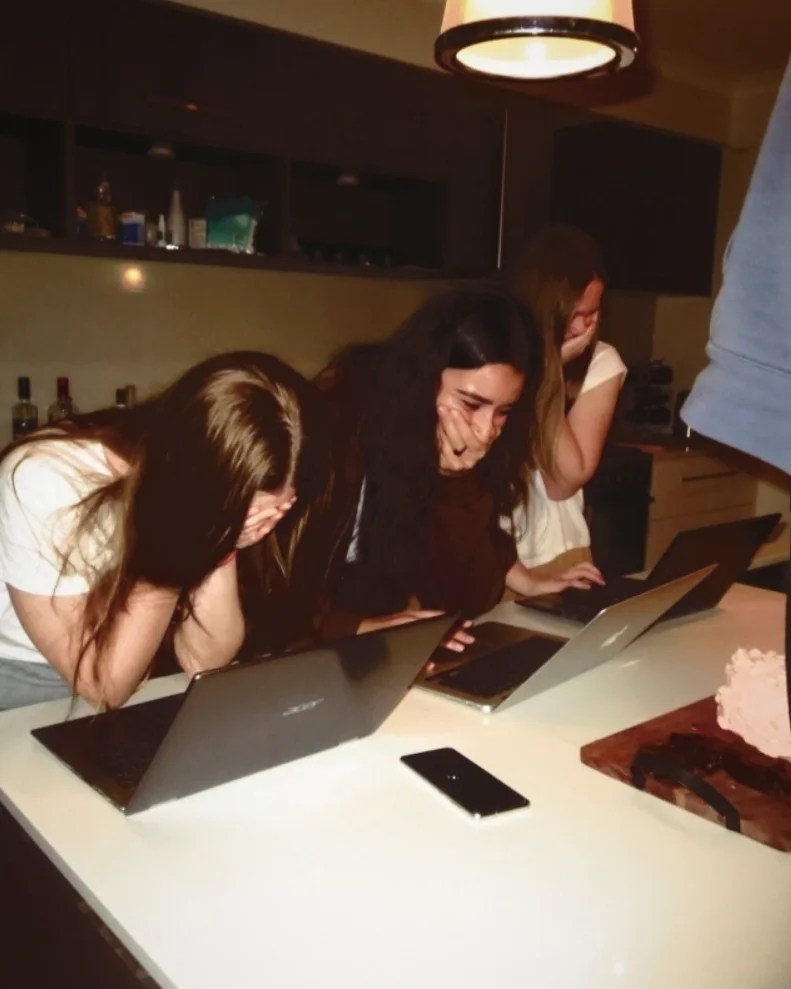
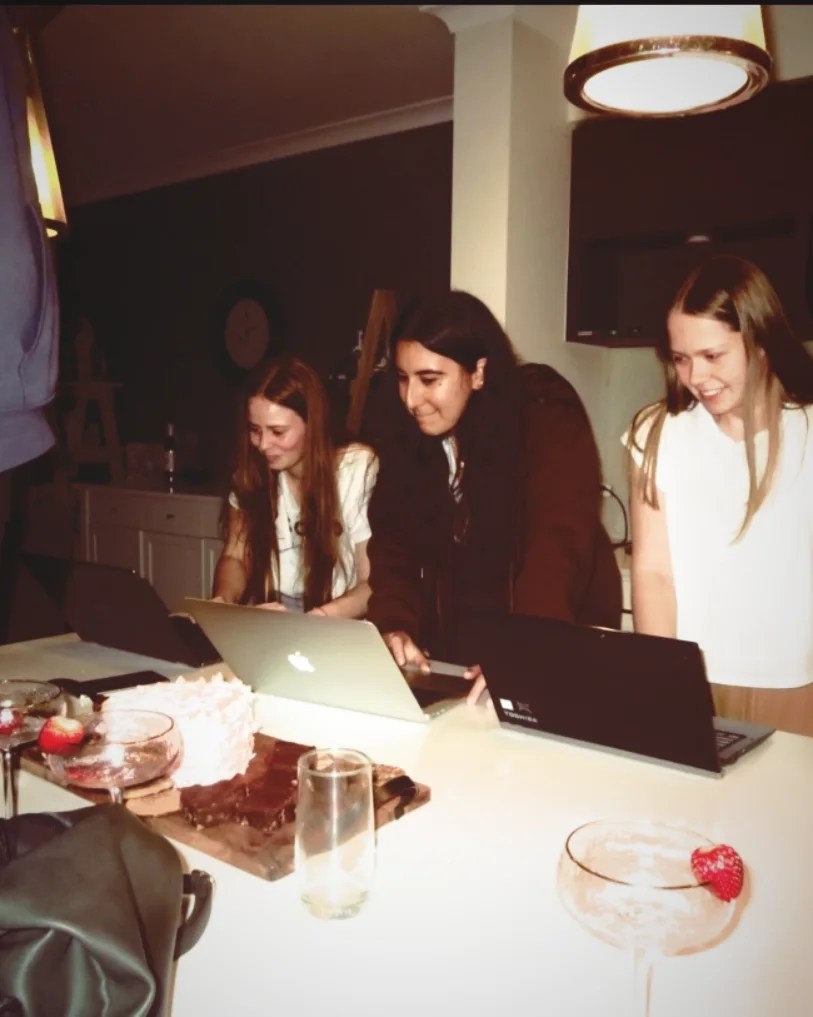
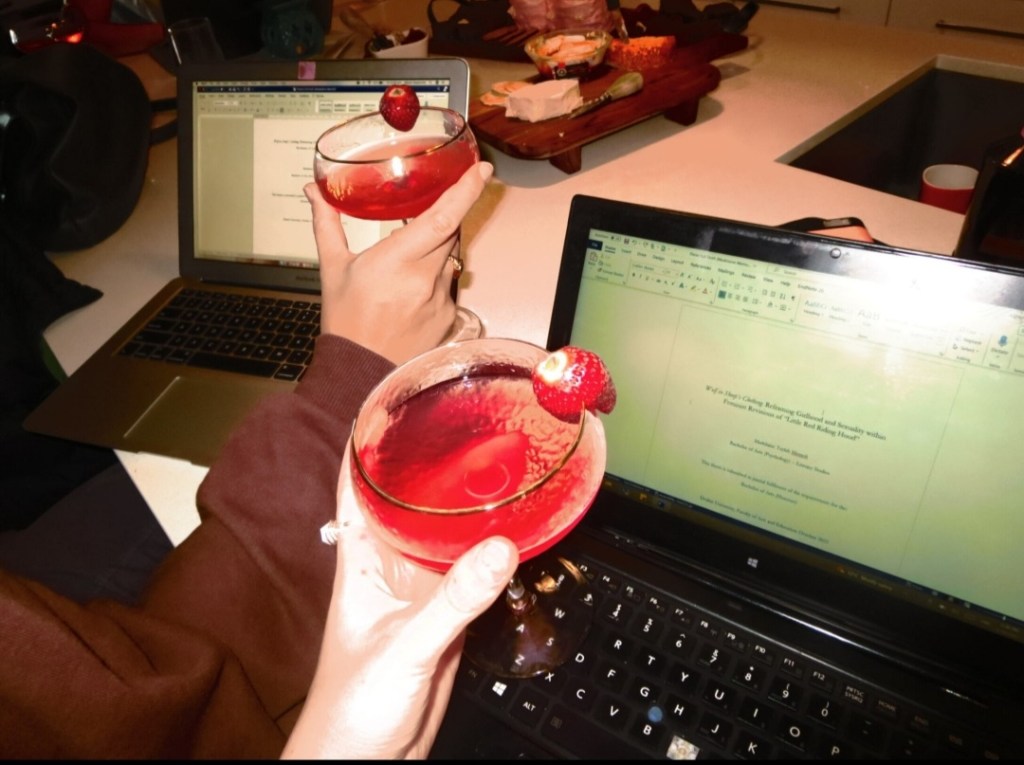
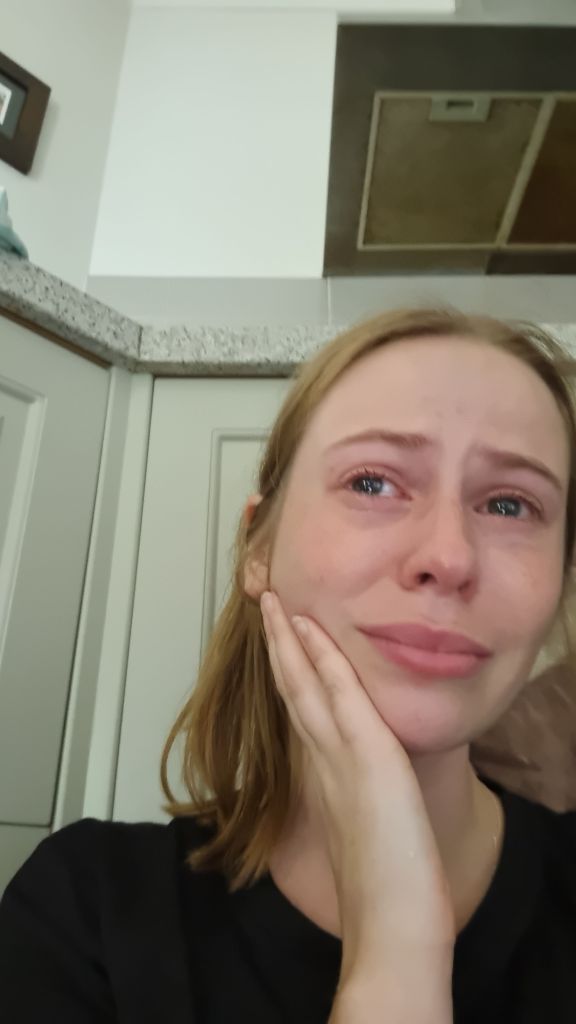
Enjoy some breakdown photo documentation :,)
Week 3: Our first assignment for Honours?!
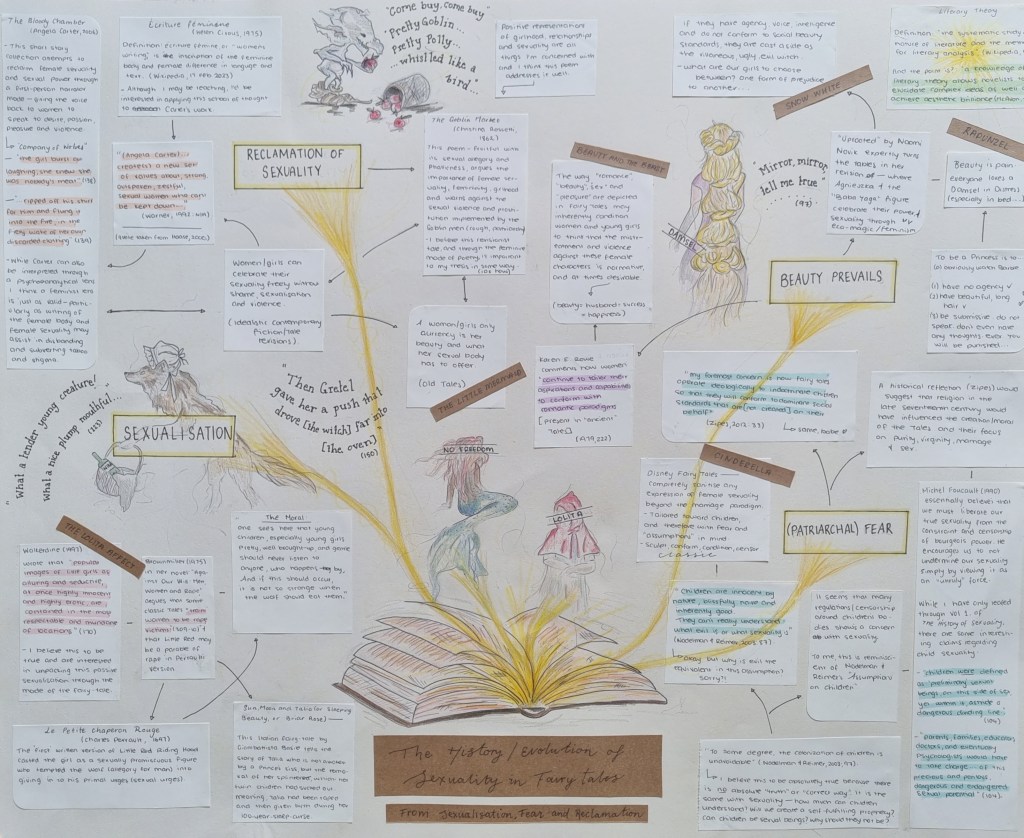
Wow this was crazy. I have NEVER felt so stupid in my life- breaking myself apart over a poster. That’s right. Our first assignment was to create a poster- a concept map outlining important schools of thought/literature/quotes etc that is relevant to our thesis, but not actually our thesis. So you could imagine the confusion. But voila! Here it is:
I managed to submit it on time (for once) and the relief was like nothing else. But I immediately broke down. All I wanted in that moment was to show Brigitte. There were a lot of emotions. I wrote a dumb poem about it in my other post, ‘Confessional Poetry: A Eulogy.
But anyway I’ve written too much already. And for who? Nobody. My own comfort I suppose. Stay tuned for an actual thesis post soon, where I dissect my current train of ideas and how its changed from my initial proposal 🙂 xx
While I believe many of us are familiar with the story of Little Red Riding Hood, I would daresay few are aware of her gruesome history. Little Red, in her glorious nymphet naivety has been brutalised with rape, misogyny, sexualisation, forced cannibalism (yes, you read that correctly) and death since her creation. It is here I would like to place a trigger warning for further reading, as I will touch on some of these themes in discussion…
Grimm vs. Perrault
I’m sure you are also aware of a few different versions of our Little Red. Such as the one where Little Red Riding Hood gets swallowed whole in the end…or maybe you know the one where the huntsman comes in and saves both her and grandmother by hacking open the sleeping wolfs stomach… OR maybe even the one where the wolf comes down the chimney and is either drowned or boiled alive by the cauldron of sausages below. Regardless of which one best describes your childhood, in typical ‘original-fairy-tale-fashion’ none of them are particularly pleasant.
While the Grimm brothers take the credit for ‘Little Red Riding Hood’, the forefather of this tale is typically awarded to French writer Charles Perrault, who wrote the earliest printed version of the tale, named Le Petit Chaperon Rouge. Like many literary fairy tales, Little Red Riding Hood is derived from peasant folklore and forgotten women writers. Originally part of an oral tradition, there are of course various versions of this Tale that can be traced all over the world; such as ‘La Finta Nonna’ or ‘The False Grandmother” in Italy, and ‘The Grandmother’ from French origins (please see the following link if you’re interested to read more, this is a good place to start).
Though for the purpose of this blog, I am choosing to only focus on the history of two of the more popular (albeit, white and Western) versions by Charles Perrault, and the Brother’s Grimm.
Illustration by Gustav Dore, 1862
“Le Petite Chaperon Rouge”
Once upon a time there lived in a certain village a little country girl, the prettiest creature who was ever seen. Her mother was excessively fond of her; and her grandmother doted on her still more. This good woman had a little red riding hood made for her. It suited the girl so extremely well that everybody called her Little Red Riding Hood.
One day her mother, having made some cakes, said to her, “Go, my dear, and see how your grandmother is doing, for I hear she has been very ill. Take her a cake, and this little pot of butter.”
Little Red Riding Hood set out immediately to go to her grandmother, who lived in another village.
As she was going through the wood, she met with a wolf, who had a very great mind to eat her up, but he dared not, because of some woodcutters working nearby in the forest. He asked her where she was going. The poor child, who did not know that it was dangerous to stay and talk to a wolf, said to him, “I am going to see my grandmother and carry her a cake and a little pot of butter from my mother.”
“Does she live far off?” said the wolf
“Oh I say,” answered Little Red Riding Hood; “it is beyond that mill you see there, at the first house in the village.”
“Well,” said the wolf, “and I’ll go and see her too. I’ll go this way and go you that, and we shall see who will be there first.”
The wolf ran as fast as he could, taking the shortest path, and the little girl took a roundabout way, entertaining herself by gathering nuts, running after butterflies, and gathering bouquets of little flowers. It was not long before the wolf arrived at the old woman’s house. He knocked at the door: tap, tap.
“Who’s there?”
“Your grandchild, Little Red Riding Hood,” replied the wolf, counterfeiting her voice; “who has brought you a cake and a little pot of butter sent you by mother.”
The good grandmother, who was in bed, because she was somewhat ill, cried out, “Pull the bobbin, and the latch will go up.”
The wolf pulled the bobbin, and the door opened, and then he immediately fell upon the good woman and ate her up in a moment, for it been more than three days since he had eaten. He then shut the door and got into the grandmother’s bed, expecting Little Red Riding Hood, who came some time afterwards and knocked at the door: tap, tap.
“Who’s there?”
Little Red Riding Hood, hearing the big voice of the wolf, was at first afraid; but believing her grandmother had a cold and was hoarse, answered, “It is your grandchild Little Red Riding Hood, who has brought you a cake and a little pot of butter mother sends you.”
The wolf cried out to her, softening his voice as much as he could, “Pull the bobbin, and the latch will go up.”
Little Red Riding Hood pulled the bobbin, and the door opened.
The wolf, seeing her come in, said to her, hiding himself under the bedclothes, “Put the cake and the little pot of butter upon the stool, and come get into bed with me.”
Little Red Riding Hood took off her clothes and got into bed. She was greatly amazed to see how her grandmother looked in her nightclothes, and said to her, “Grandmother, what big arms you have!”
“All the better to hug you with, my dear.”
“Grandmother, what big legs you have!”
“All the better to run with, my child.”
“Grandmother, what big ears you have!”
“All the better to hear with, my child.”
“Grandmother, what big eyes you have!”
“All the better to see with, my child.”
“Grandmother, what big teeth you have got!”
“All the better to eat you up with.”
And, saying these words, this wicked wolf fell upon Little Red Riding Hood, and ate her all up.
(Perrault: 1697)
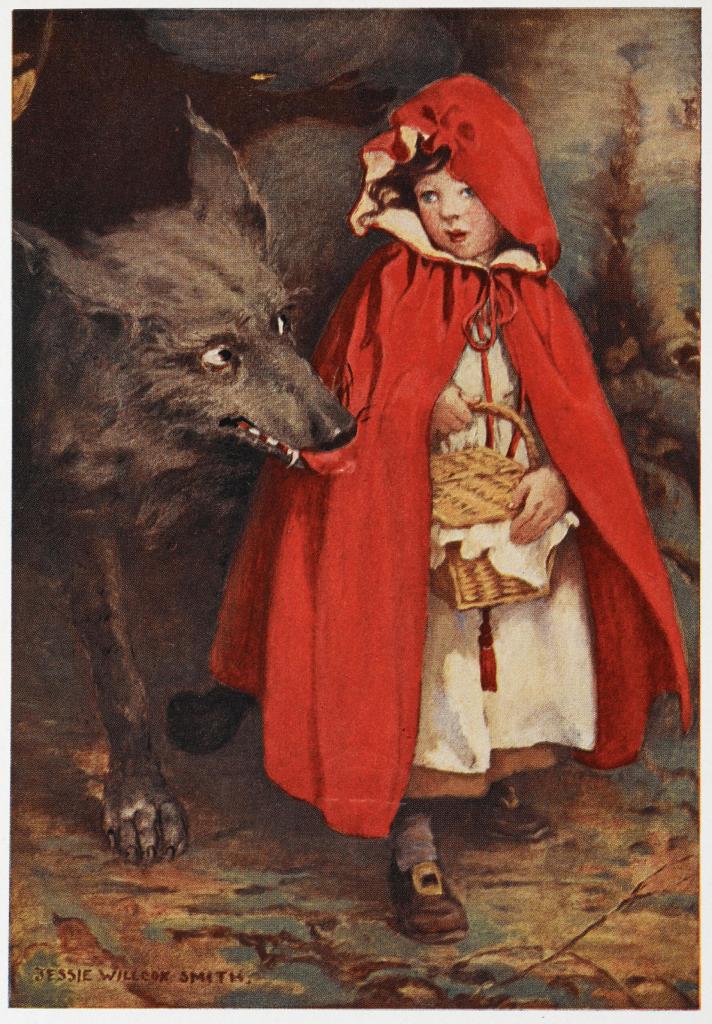
Before we compare this tale to that of the Brother’s Grimm, I would like to quickly note some of the phrases I have bold/underlined. First and foremost, lets address the name ‘little red riding hood.’ Up until Perrault’s version, there was no mention of the little girl wearing a red hood, meaning that he was the first to introduce this bit of characterisation. But why? We only learn that she was so fond of the hood her grandmother made her, that they began to call her little red riding hood. But why would her grandmother make her a riding hood, when she clearly does not ride horses? In the story, we see that she walks to grandmother’s house, and there is no mention otherwise that she even rides outside of the story. Perhaps it would have made more sense to call it a cloak, robe or cape. Maybe I’m reaching, but I cannot help wondering if there is a sexual innuendo here, particularly if you pair it with Perrault’s “moral” at the end of the story (I will show you shortly).
If we go a little bit further and analyse some of the symbolism behind the colour red, we find that it often presents wealth (“well-bred”, noble, rich), promiscuity (sexually vibrant), violence, blood and puberty (first bleeding and also the breaking of the hymen). Perhaps red capes were just the fashion of the time, or maybe their is more symbolic meaning to grasp. I’ll let you look into this one more if you wish.
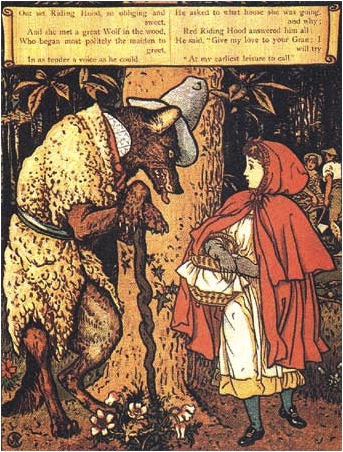
Perrault also makes it a point to highlight Little Red’s naivety and ignorance by showing how trusting and easily deceived she is. She takes the ’roundabout’ way to her grandmothers, interacts with the wolf not understanding that she should not trust strangers, no matter how kind and gentle they seem. When the wolf, disguised as grandmother instructs her to come into bed with them, Little Red obliges with little questioning or consideration of the request. Even upon realising how strange ‘grandmothers’ features are, there is no alarm behind her questioning, but a cat-and-mouse game of sexual tension before the wolf ‘falls upon her’ and ‘eats her up’. Otherwise, an implication for rape. Perrault casts Little Red as a sexual figure who teases the wolf’s primitive sexual urges with her promiscuity and ‘feigned’ innocence. A CHILD. A GIRL. I think it is time to hear the moral Perrault set out for this Tale as summarised by Jack Zipes…
One sees here that young children, especially young girls
Pretty, well brought-up, and gentle,
Should never listen to anyone who happens by,
And if this occurs, it is not so strange
When the wolf should eat them
(Zipes, 1993: 93)
Like what in the fuck… if you were sceptical before, I hope that this has convinced you now. Perrault was trying to sexualise this little girl, and then BLAME her for her own violation. As best said by Elizabeth Marshall (2004), “[about the girl climbing into bed naked and the wolf eating her] Here, modes of behaviour suggest that the girl is responsible for her violation and that to avoid physical harm (in this case rape and murder) a young girl must dodge the advances of suave wolves (men)” (263), that “it could be argued that Little Red’s feminine body invited the sexual advances of the wolf” (263).
Instead of warning children about sexual predators and stranger danger, (blaming the rapists for raping), children (girls) are taught that it is their own fault if they entice the ‘wolf’ because it is simply in (his/her/their) nature. But how could you blame a child for this disgusting violation against them? Even in the case that the child attempts to sexualise themselves, we must ask WHY. Most likely it is because Humbert the wolf is grooming the little red Lolita into thinking this is normal and desirable (I am referencing Nabovok’s Lolita here. It is a classic and while I must put a trigger warning on it now as its themes are disturbing, Nabokov is sadly an EXCELLENT writer and you should check it out).
“Little Red Cap”- Grimm’s
Once upon a time there was a dear little girl who was loved by every one who looked at her, but most of all by her grandmother, and there was nothing that she would not have given to the child. Once she gave her a little cap of red velvet, which suited her so well that she would never wear anything else; so she was always called ‘Little Red-Cap.’
One day her mother said to her, “Come, Little Red-Cap, here is a piece of cake and a bottle of wine; take them to your grandmother, she is ill and weak, and they will do her good. Set out before it gets hot, and when you are going, walk nicely and quietly and do not run off the path, or you may fall and break the bottle, and then your grandmother will get nothing; and when you go into her room, don’t forget to say, ‘Good-morning,’ and don’t peep into every corner before you do it.”
“I will take great care,” said Little Red-Cap to her mother, and gave her hand on it.
The grandmother lived out in the wood, half a league from the village, and just as Little Red-Cap entered the wood, a wolf met her. Red-Cap did not know what a wicked creature he was, and was not at all afraid of him.
“Good-day, Little Red-Cap,” said he.
“Thank you kindly, wolf.”
“Whither away so early, Little Red-Cap?”
“To my grandmother’s.”
“What have you got in your apron?”
“Cake and wine; yesterday was baking-day, so poor sick grandmother is to have something good, to make her stronger.”
“Where does your grandmother live, Little Red-Cap?”
“A good quarter of a league farther on in the wood; her house stands under the three large oak-trees, the nut-trees are just below; you surely must know it,” replied Little Red-Cap.
The wolf thought to himself, “What a tender young creature! what a nice plump mouthful she will be better to eat than the old woman. I must act craftily, so as to catch both.” So he walked for a short time by the side of Little Red-Cap, and then he said, “See, Little Red-Cap, how pretty the flowers are about here why do you not look round? I believe, too, that you do not hear how sweetly the little birds are singing; you walk gravely along as if you were going to school, while everything else out here in the wood is merry.”
Little Red-Cap raised her eyes, and when she saw the sunbeams dancing here and there through the trees, and pretty flowers growing everywhere, she thought, “Suppose I take grandmother a fresh nosegay; that would please her too. It is so early in the day that I shall still get there in good time;” and so she ran from the path into the wood to look for flowers. And whenever she had picked one, she fancied that she saw a still prettier one farther on, and ran after it, and so got deeper and deeper into the wood.
Meanwhile the wolf ran straight to the grandmother’s house and knocked at the door.
“Who is there?”
“Little Red-Cap,” replied the wolf. “She is bringing cake and wine; open the door.”
“Lift the latch,” called out the grandmother, “I am too weak, and cannot get up.”
The wolf lifted the latch, the door flew open, and without saying a word he went straight to the grandmother’s bed, and devoured her. Then he put on her clothes, dressed himself in her cap, laid himself in bed and drew the curtains.
Little Red-Cap, however, had been running about picking flowers, and when she had gathered so many that she could carry no more, she remembered her grandmother, and set out on the way to her.
She was surprised to find the cottage-door standing open, and when she went into the room, she had such a strange feeling that she said to herself, “Oh dear! how uneasy I feel to-day, and at other times I like being with grandmother so much.” She called out, “Good morning,” but received no answer; so she went to the bed and drew back the curtains. There lay her grandmother with her cap pulled far over her face, and looking very strange.
“Oh! grandmother,” she said, “what big ears you have!”
“The better to hear you with, my child,” was the reply.
“But, grandmother, what big eyes you have!” she said.
“The better to see you with, my dear.”
“But, grandmother, what large hands you have!”
“The better to hug you with.”
“Oh! but, grandmother, what a terrible big mouth you have!”
“The better to eat you with!”
And scarcely had the wolf said this, than with one bound he was out of bed and swallowed up Red-Cap.
When the wolf had appeased his appetite, he lay down again in the bed, fell asleep and began to snore very loud. The huntsman was just passing the house, and thought to himself, “How the old woman is snoring! I must just see if she wants anything.” So he went into the room, and when he came to the bed, he saw that the wolf was lying in it. “Do I find thee here, thou old sinner!” said he. “I have long sought thee!”
Then just as he was going to fire at him, it occurred to him that the wolf might have devoured the grandmother, and that she might still be saved, so he did not fire, but took a pair of scissors, and began to cut open the stomach of the sleeping wolf. When he had made two snips, he saw the little Red-Cap shining, and then he made two snips more, and the little girl sprang out, crying, “Ah, how frightened I have been! How dark it was inside the wolf;” and after that the aged grandmother came out alive also, but scarcely able to breathe.
Red-Cap, however, quickly fetched great stones with which they filled the wolf’s body, and when he awoke, he wanted to run away, but the stones were so heavy that he fell down at once, and fell dead.
Then all three were delighted. The huntsman drew off the wolf’s skin and went home with it; the grandmother ate the cake and drank the wine which Red-Cap had brought, and revived, but Red-Cap thought to herself, “As long as I live, I will never by myself leave the path, to run into the wood, when my mother has forbidden me to do so.”
(Jacob and Wilhelm Grimm, Household Tales, trans. Margaret Hunt: 1884)
As we can see, the Brother’s Grimm offered a more sanitised version of this Tale, by revising the sexualisations and re-positioning the moral of the Tale to be that; good and obedient children who obey their mother’s and do not stray from the path, should not find themselves in dangerous situations, and that one can count on a strong man to save the day. Though I am immensely glad this version of the Tale has traversed the children’s literature canon rather than Perrault’s, I am still apprehensive of the other messages this Tale sends.
‘My foremost concern is how fairy tales operate ideologically to indoctrinate children so that they will conform to dominant social standards that are not necessarily established in their behalf.’
(Zipes, 2012: 33)
Again, I have underlined/bolded some phrases within the story. However, I will not be unpacking them in this post any further. For now I’ll just throw this into the void and let it sit with you here. But you might like to consider how physical violence is presented to be more palatable in this story, or the slight changes in what Little Red was carrying or wearing… and even the social and gender norms presented, what is or isn’t ‘proper’ or ‘lady-like.’ If you have made it this far, thank you for reading, there is sooo much more to say, but perhaps for another day 🙂
I would love to hear any other interpretations as well! So please feel free to comment if you’d like, or otherwise reach out to me through my Instagram Page: thatgirl_books






 That Girl Books